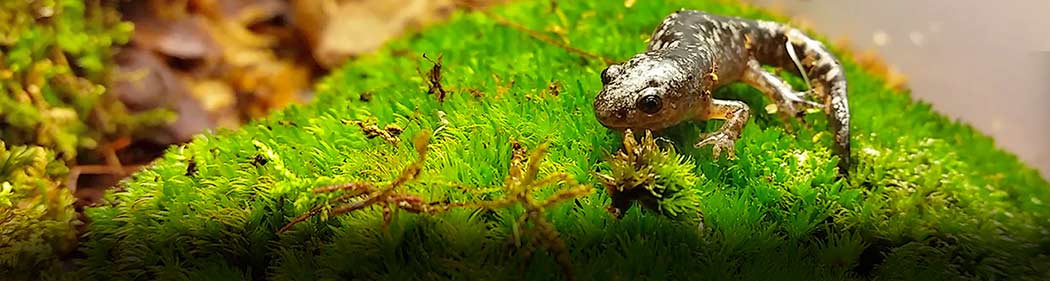
We've begun the first marbled salamander reintroduction project in Massachusetts, bringing these amphibians back to Metro-Boston.
Returning Marbled Salamanders to a Former Home in Massachusetts
Working together with the Massachusetts Division of Fisheries and Wildlife, the Friends of the Fells, and several local high schools, we've begun to reintroduce marbled salamanders to one of their most important former homes in northeastern Massachusetts, the Middlesex Fells. In 2016, we released the first group of young marbled salamanders in the Fells, possibly the first members of their species to occupy this area in almost a century.
Each year from 2015-2025, under the guidance of the Massachusetts Natural Heritage and Endangered Species Program, we safely removed newly-hatched marbled salamander larvae from winter-cold vernal pools in western Massachusetts, raised the aquatic larvae through their transformation into air-breathing juvenile salamanders, and released them near suitable vernal pools in the Middlesex Fells.
In addition to raising the salamanders at Stone Zoo, area high schools, including Medford High School, raised the salamanders in their science classrooms, allowing local students to get involved in the project and make a difference for wildlife in their community.
In the spring of 2023, volunteers with ZNE’s partner organization Earthwise Aware discovered the first marbled salamander larvae to hatch at the Middlesex Fells in almost 100 years. These larvae were the confirmation we had been waiting for that our released juveniles are surviving, growing, and mating successfully in the wild. Subsequent nighttime surveys also found several wild adult marbled salamanders near the same pool! This population is likely still small and will need continued help and monitoring, but this successful reintroduction fills our team with hope for the future.
In the next few years, we hope to map out breeding sites used by the salamanders in the Fells, document how well cohorts of larvae survive to metamorphosis, and look for changes in the population over time.
Visit our Conservation blog for updates on our work with salamanders
About the Marbled Salamander
The marbled salamander (Ambystoma opacum) is a beautiful, relatively large salamander ranging from Florida to southern New Hampshire. Uniquely among the 12 salamander species native to New England, marbled salamanders lay their eggs in the late summer or early autumn in the dry parts of the vernal pool and their young hatch at the onset of winter as rain fills the pool. As larvae, marbled salamanders grow actively under the ice of frozen vernal pools, metamorphosing into strikingly silver patterned juveniles in the spring and early summer, before heading into dry, upland woodlands to complete their growth to adulthood.
At the northern edge of their range, marbled salamanders are listed as Threatened species in Massachusetts and as a critically imperiled Endangered species in New Hampshire. In Massachusetts, marbled salamanders have essentially disappeared from Essex and Middlesex Counties, where a number of local populations were observed into the late 20th century. The only substantial population known to remain in the local Boston area breeds in a number of vernal pools in the Blue Hills, south of Boston. Relatively little is known, however, about the distribution, habits and breeding sites of the Blue Hills marbled salamander population.
Middlesex Fells, a very large tract of rocky forest and wetlands located only five miles from Boston, is one of the former homes of marbled salamanders in northeastern Massachusetts. Marbled salamanders were observed and collected in the Fells in 1932, near the peak of forest loss and alteration in the area. They haven't been seen in the Fells or in surrounding communities since that time. In the latter part of the 20th century, however, the forest and natural undergrowth in the Middlesex Fells has recovered and biologists have documented more than 100 vernal pools in the area, many of which might provide excellent breeding habitat for the marbled salamander. On their own, however, marbled salamanders, now largely extirpated from northeastern Massachusetts have no chance of crossing the highways that ring the Fells and repopulating the area.
Like the closely related but more common spotted salamander (Ambystoma maculatum), marbled salamanders depend upon complex natural landscapes, where individuals, over the course of their lives, can have access to both healthy forests and a range of vernal pools with different annual periods of flooding. Near the northern edge of their range, local populations of marbled salamanders are often rare to start with and these populations will dwindle or disappear as either the critical forest or wetland components are lost or degraded. Roads and cleared areas, moreover, can form barriers to salamander movement, effectively cutting individuals off from access to critical breeding or adult habitat.
Historically, many vernal pool breeding sites used by marbled salamanders were filled or drained. Woodlands, where the salamanders live for most of their lives, have been cut down, logged heavily, and have had their critical undergrowth altered by invasive plant species. Conversely, when excessive rain events cause vernal pool water levels to stay high, this could impede egg laying. Remaining vernal pools in New England may be polluted with road salt and pesticides, all of which can kill or damage salamander eggs and larvae.
Additionally, a major infectious disease of salamanders, the skin fungus Batrachochytrium salamandrovirans, appears to have been widely spread by people, possibly through the pet trade in salamanders native to Asia where the fungus may have originated. Though currently unknown in North America, this devastating disease could easily be introduced here without careful management of the international trade in frogs and salamanders. Finally, climate change may worsen an already difficult situation, especially if recent trends towards longer periods of dry or wet weather in late autumn become the norm. Though warmer temperatures in October through December could be a boon to developing marbled salamander embryos, these gains can be easily offset by prolonged late autumn droughts, which may result in total hatching failure.