
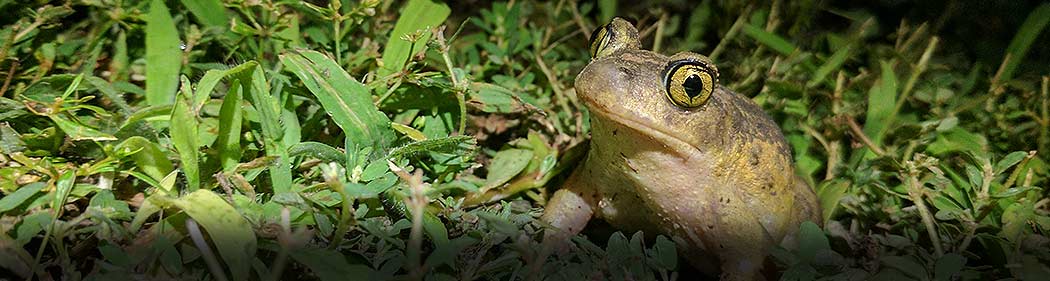
Eastern spadefoot toad
Eastern Spadefoot Toad Conservation
Since 2009, we’ve worked with MassWildlife and Mass Audubon to boost beleaguered populations of Massachusetts’ most unique amphibian, the eastern spadefoot toad, by monitoring, creating, and improving their breeding habitat.
Spadefoot toads are not true toads or true frogs, but they are truly interesting! Palm-sized, with cat-like pupils, these fossorial frogs spend much of their time buried under sand. They're also gamblers: their breeding strategy involves choosing small, extremely ephemeral pools. If the weather cooperates, the small pools ensure a warm and predator-free sanctuary for their young. But not enough rain can spell danger for the aquatic tadpoles. Spadefoot toads have been hit hard by climate change, habitat fragmentation, and fill-in of their breeding pools, and are considered Threatened and a Species of Greatest Conservation Need in MA.
Starting in 2009, we partnered with Mass Audubon’s Long Pasture Wildlife Sanctuary to help restore the eastern spadefoot toad to areas of its former range. Under the leadership of sanctuary director Ian Ives, and with the help of noted wetland restoration expert Thomas Biebighauser, we helped create 13 new, small vernal pools at Ashumet Holly and Long Pasture Wildlife Sanctuaries, and stocked the pools with more than 8,000 spadefoot toadlets, rescued from drying pools and raised by local schoolchildren. This pilot reintroduction project ran through 2018. The effort took years to bear fruit – but in 2021, adults were recorded calling from the brand new pools, and in 2022, the spadefoot toads bred successfully.
Zoo New England biologists continue to monitor for spadefoot toads at several sites around Massachusetts, and assist with habitat management.
About the Eastern Spadefoot Toad
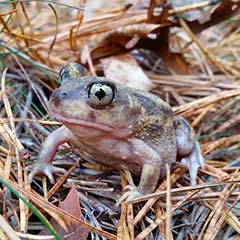 The eastern spadefoot toad (Scaphiopus holbrookii) is an odd descendant of desert-dwellers marooned in wet and cold New England. Our spadefoot toads reach the northern limits of their range in Massachusetts and New York states. None have been documented in New Hampshire. Eastern spadefoot toads are the rarest frog species in Massachusetts and, with the exception of Vermont’s boreal chorus frog, the rarest frog in New England overall. They're rare in all the northeastern states in which they occur. In Massachusetts, spadefoot toads, a threatened species, are primarily found on the outer parts of Cape Cod, with other significant but local populations in southeastern Massachusetts, Nantucket, Martha’s Vineyard, and Plum Island. A few small populations persist in the Connecticut River Valley and one tiny known population remains in Middlesex County.
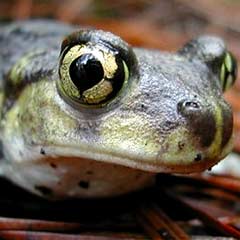
Eastern spadefoot toads spend the bulk of their lives underground in dry, sandy soils. They breed sporadically and unpredictably, usually in the spring months but occasionally throughout the summer and always in response to heavy rains. Males call from suitable vernal pool habitat with a whining “bleat” during the short, unpredictable breeding season. Females lay gelatinous egg masses, which hatch in several days into tadpoles that develop a characteristic pattern of gold flecking. Since eastern spadefoot toads typically select relatively small, shallow, and very ephemeral vernal pools as their breeding sites, many large groups of tadpoles perish if a dry spell causes their breeding pools to vanish before the tadpoles can metamorphose. As juveniles and adults, eastern spadefoot toads are nocturnal and come out of their burrows to feed on ants and other invertebrates during warm, often moist nights. They have large “cat-like” eyes and their hind feed each possess a small specially adapted “claw” or “spade,” which allows them to burrow into the sand in a surprisingly short time.
Eastern spadefoot toads are very hard to find, even with the benefit of modern equipment. We therefore know little about their past distribution in our area. However, museum specimens and descriptions demonstrate that they were once considerably more widespread in northeastern Massachusetts, including historical reports from Cambridge, Concord, and several towns in Essex County.
The Threat
 Likely, a primary cause of the decline of eastern spadefoot toads throughout their range has been the filling and draining of the small, ephemeral vernal pools that spadefoot toads depend upon as breeding habitat. Since they inhabit dry, sandy portions of the coastal plain in the northeastern United States, much of their habitat has been destroyed through centuries of urbanization and agriculture. Pesticides and pollutants may be a threat to eggs and tadpoles, and some Massachusetts adults have tested positive for a skin fungus, Batrachochytrium dendrobatidis, that has caused frog declines and extinctions in several areas of the world. Locally, however, it's unlikely that this disease is a major threat to New England’s remaining spadefoot toad populations.
Climate change, on the other hand, could further endanger our rarest frog. Long spring dry spells, such as those which occurred in 2015 and especially 2016, may prohibit spadefoot toad populations from breeding, sometimes for years at a time. Droughts that occur after breeding events can doom all the tadpoles in a population to death by desiccation. Additionally, rising sea levels may threaten some of our most robust spadefoot toad populations which occur on barrier beaches.