Skip main navigation

Saturday, August 29: Due to events taking place outside the Zoo, Franklin Park Zoo will be closed all day. Boston Lights will also be closed that evening. Thank you for your understanding, and we hope to see you on another day. 

x
Close menu

Bufflehead Duck

Bucephala albeola
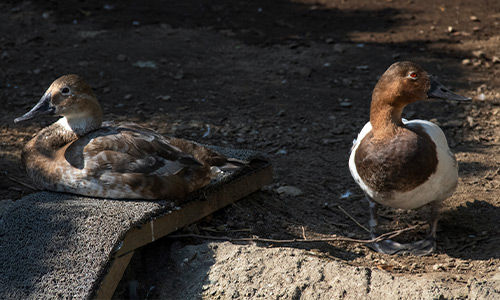
  • bufflehead duck
  • bufflehead duck
  • bufflehead duck
  • bufflehead duck

About the Bufflehead Duck

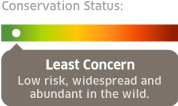
conservation status: least concern

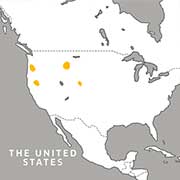
Geographic Range:

range map

Class: Aves  
Order: Anseriformes
Family: Anatidae
Genus: Bucephala
Species: albeola

Buffleheads are among the smallest ducks in North America, but don’t let their tiny size fool you—they’re energetic divers and spend much of their day searching underwater for food in ponds and lakes. You’ll rarely see a bufflehead walking on land; they’re much more at home in the water. When it’s time to raise a family, these resourceful ducks don’t build their own nests. Instead, they seek out existing cavities, often taking over old nesting sites created by other animals.

Bufflehead Duck Facts

Appearance:
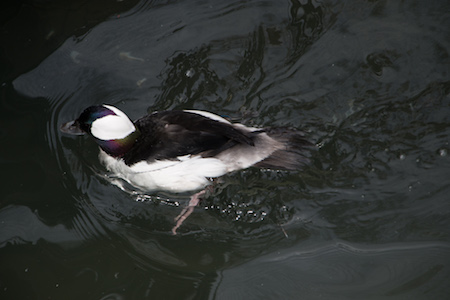
Named for the rounded shape of their heads, buffleheads are one of the smallest breeds of duck in North America. Males are generally larger than females, and are more brightly colored in black, white, and iridescent purple and green on their face. Females are more muted in color, being mostly gray. All buffleheads have white patches behind their eyes. 

Size:

  • Weight: 13 ounces
  • Length: 14 inches

Diet:
Aquatic invertebrates, crustaceans, mollusks, insect larvae, snails, clams and seeds. 

Reproduction:
These monogamous birds typically breed in late winter or spring. Buffleheads use nests constructed by other species. They typically look for hollowed out cavities in trees close to a body of water. Nests remain fairly minimal, as buffleheads do not add additional materials. Females have been known to scout out nest locations far in advance. After an incubation period of 30 days, they lay anywhere from 4-17 cream-colored or buff eggs.

Behavior:
Buffleheads spend most of their time in water preening, swimming, diving or foraging. They seldom walk on land, however adults without nests may sleep on the shoreline. They're often found in small flocks upwards of 10 individuals.

Range/Habitat:
North American ponds or lakes. They spend winters in lakes, estuaries or salt bays.

Threats:
Bufflehead are losing nest sites as loggers clear-cut boreal forest, and as agricultural fields replace aspen parklands in western North America.

How you can help:
Putting up nest boxes with small (2.5-inch diameter) openings in appropriate habitat can help. Download a construction plan for a bufflehead nestbox.