Skip main navigation

Sunday, October 11, Franklin Park Zoo: Due to events happening within the park, a portion of Circuit Drive will be closed until approximately 2:30 p.m. Guests may enter and exit the Zoo via the Zebra Entrance on Blue Hill Avenue. Parking lots near this entrance will be available while a portion of Circuit Drive is closed. The parking lot on Pierpont Road near the Zoo’s Giraffe Entrance will reopen after approximately 2:30 p.m. All roadways will be available for our evening Boston Lights event. 


x
Close menu

Spotted turtle

Clemmys guttata

⚠️ Animal Alert
Spotted turtles are off exhibit if it's below 68 degrees. Visit our Winter Visits page to learn more about the amazing animals you can see during the winter.
  • spotted turtle
  • spotted turtle
  • spotted turtle
  • spotted turtle


About the Spotted turtle

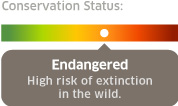
conservation status: endangered

Class: Reptilia   
Order: Testudines  
Family: Emydidae
Genus: Clemmys 
Species: guttata

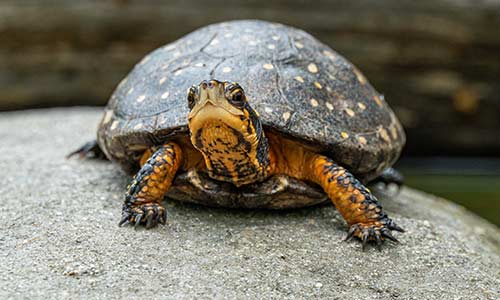
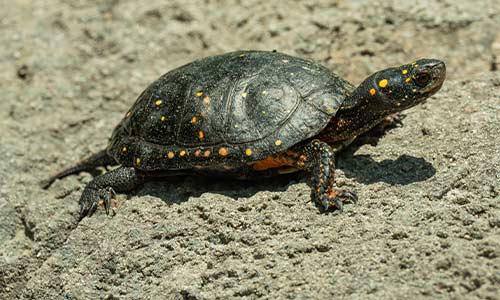
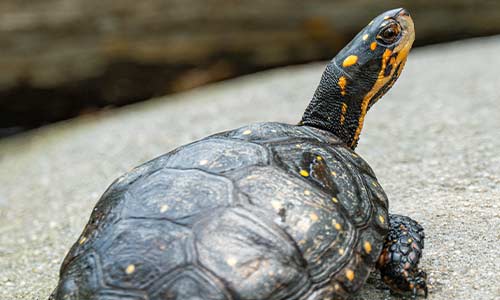
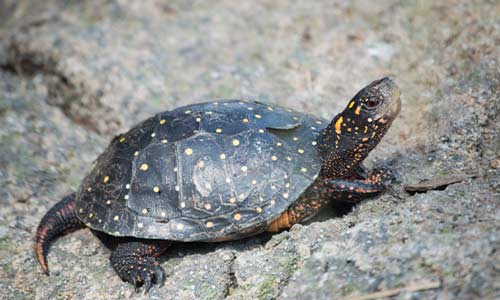
Small but striking, spotted turtles are easy to recognize by the bright yellow spots scattered across their dark shells and skin. These semi-aquatic turtles make their homes in wetlands, ponds, streams and other shallow-water habitats, where they spend their days basking and searching for snails, worms, slugs and aquatic plants. Spotted turtles can live 25–30 years in the wild and often return to the same hibernation sites year after year. But despite their resilience, they face threats from habitat loss and predators, making the protection of healthy wetlands especially important for their future.

Spotted Turtle Facts

Appearance:
Spotted turtles are small, semi-aquatic turtles. They have distinct yellow spots that cover their limbs and shell. Their carapace (top part of shell) is typically black and not highly domed. The turtle's plastron (bottom part of shell) is yellow and black. Males have a darker pigment on the hard portion of their jaws, while females have a yellowish coloration. Males tend to have brown eyes, whereas females' eyes are often orange.

Size:
Shell length: 3.5 – 5 inches

Diet:
Spotted turtles are omnivorous. Their diet mainly consists of snails, worms, slugs and spiders, but it can also include aquatic vegetation and green algae.

Reproduction:
Breeding season is in mid-spring. During this period, males engage in an active, almost frenzied pursuit of females. Multiple males may attempt to pursue a single female. When the female is ready for mating, she lets one male catch her and they mate.

Incubation:
Nesting typically occurs in May. Female spotted turtles may wander far from their breeding pools in search of nesting sites. An open site such as a meadow or field is usually chosen for the nest. She lays three to seven eggs and uses her body to smooth the dirt after burying them. Eggs hatch 70-80 days later.

Behavior:
Daylight hours are spent eating or basking. During the evening, spotted turtles retreat into the water and spend the night on the bottom of the pond. Turtles hibernate in groups during the winter, often returning to the same hibernation site year after year.

Role in their habitat:
Prey species. They are particularly vulnerable to raccoons or muskrats.

Habitat/range:
The spotted turtle occupies a variety of habitats including bogs, marshes, woodland streams, vernal pools, swamps and sedge meadows. They can also be found in some brackish streams. These turtles range from parts of Canada, as well as south along the eastern United States, extending to Florida.

Median Life Expectancy:
25-30 years in the wild

Fun Facts:

  • Spotted turtles have been known to walk long distances over land to reach nesting sites, often crossing roads and developed areas.
  • Temperature effects embryonic development. Some researchers claim that the effects of climate change may severely impact population sex ratios.