Skip main navigation

Sunday, October 11, Franklin Park Zoo: Due to events happening within the park, a portion of Circuit Drive will be closed until approximately 2:30 p.m. Guests may enter and exit the Zoo via the Zebra Entrance on Blue Hill Avenue. Parking lots near this entrance will be available while a portion of Circuit Drive is closed. The parking lot on Pierpont Road near the Zoo’s Giraffe Entrance will reopen after approximately 2:30 p.m. All roadways will be available for our evening Boston Lights event. 


x
Close menu

Ball Python

Python regius

  • anaconda
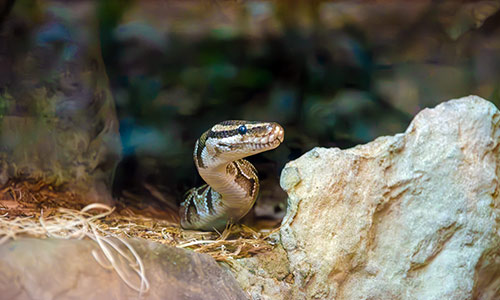
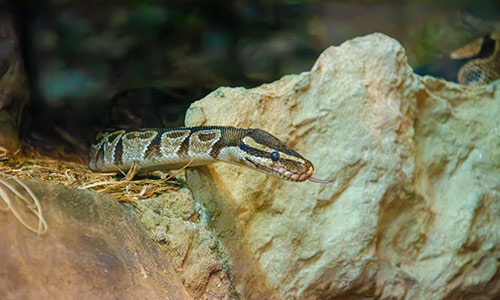
  • ball python peeking out from the rocks
  • anaconda
  • ball python
  • ball python
  • ball python
  • ball python
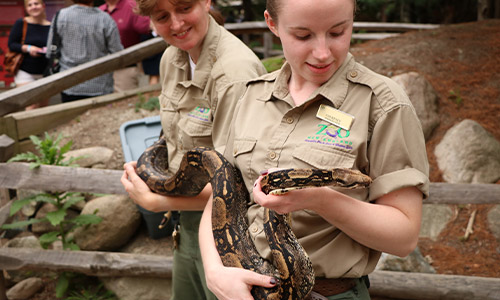
  • care team with ball python
  • ball python
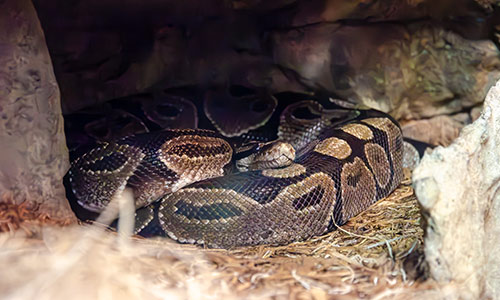
  • ball python curled up

About the Ball Python
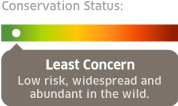
conservation status: least concern

Class: Reptilia
Order: Squamata
Suborder: Serpentes
Family: Pythonidae
Genus: Python
Species: regius

Small but fascinating, ball pythons are the smallest of Africa’s pythons and are perfectly adapted to life on the night shift. These non-venomous constrictors spend their days tucked away in underground burrows and termite mounds, emerging after dark to hunt for small mammals, birds, reptiles, and other prey. When it’s time to reproduce, females lay several eggs and coil tightly around them, using their bodies to help keep the eggs warm as they develop. With their striking dark-and-gold patterns and secretive lifestyle, ball pythons have plenty of fascinating adaptations to discover.

Ball Python Facts

Appearance:
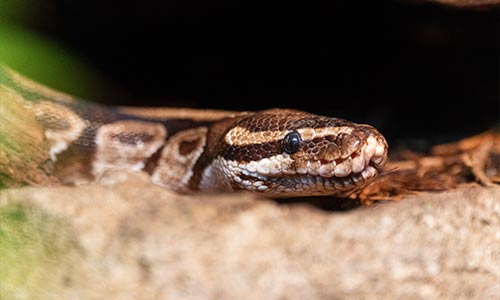
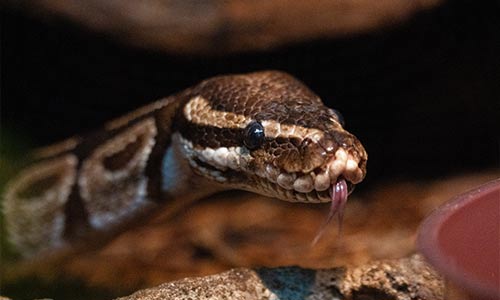
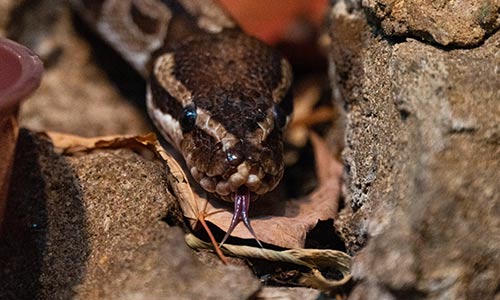
Ball pythons are black in color with light brown or gold sides and dorsal blotches. Their bellies are typically white or cream and may or may not have black markings. This species is the smallest of the African pythons.

Size:
Length: 92-122 centimeters (36-48 inches)

Reproduction:
Ball pythons are oviparous, meaning they lay eggs to reproduce. Their breeding season spans mid-September through mid-November, during the rainy season. Incubation of the eggs last for around 90 days, during which time the mother will coil around eggs to keep them warm. Female ball pythons typically lay between 3-11 eggs at a time. Females grow to maturity at the age of 24-36 months, while males mature at 12-18 months of life.

Life Expectancy:
Ball pythons typically live to be up to 10 years old in the wild.

Habitat:
These snakes inhabit areas of mixed grassland, sparsely wooded areas, and savanna in Western and West Central Africa.

Diet:
Ball pythons are a non-venomous constrictor species, meaning they catch prey by wrapping their body around the prey and constricting it. Prey includes amphibians, lizards, snakes, birds and small mammals.

Behavior:
This snake species is entirely nocturnal, meaning it is active solely at night. This snake spends its days in underground rodent burrows and termite mounds, sunbathing for warmth when needed.