Appearance:
The green-winged macaw has a partly red plumage and a blue back and rump. Its long tail is tipped with blue, and its wings are blue with dark green upper wing coverts. Their facial patch is white with red feathers striped throughout. Juvenile macaws resemble adults but have shorter tails.
The macaw’s upper beak is strongly hooked and horn-colored, and their lower beak is black. These powerful beaks are designed to crush or open even the hardest nuts and seeds. Beaks are also used as a third foot to help grasp onto and climb trees. Their dry, scaly tongues have a bone inside that serves as an effective tool for tapping into fruits.
Macaws have gray legs and feet that are zygodactylous (two toes that point forward and two toes that point backwards). Their short, sturdy legs are useful for hanging sideways and upside-down.
Size:
- Length: 36 inches
- Wingspan: Approximately 4 feet
- Weight: 2.5 – 3.5 pounds
Diet:
Nuts, fruits, seeds, insects and grains. Macaws ingest mineralized sand and clay, which helps neutralize the toxins in the seeds and nuts they eat.
Reproduction:
Green-winged macaws are monogamous, usually remaining with one partner for their entire life. They breed from November through April, during the wet season. They incubate eggs for 28 days, laying one to two eggs per season. Chicks’ first down feathers appear around eight days after hatching, and their eyes open after approximately 15 days. Their first feather sheaths emerge at about 3 weeks of age. Chicks fledge after 90 days, and they’re independent at 6 to 12 months of age. Macaws reach sexual maturity at 3 to 4 years of age.
Behavior:
These birds travel in flocks, often accompanied by raucous screaming. They have regular roost sites for the evenings and in the early morning will wake and fly to their feeding grounds.
Habitat/range:
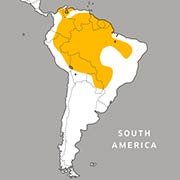
Macaws can be found in forests, swamplands, open savannahs, palm groves, and along riverbanks. They live throughout north and central South America from Panama to Paraguay and east to the Guianas and Trinidad, south to Argentina.
They prefer humid, lowland forests, but in the southern part of their range, they frequent open habitats including deciduous forests.
Role in their habitat:
Macaws serve an important role in their ecosystem by dispersing seeds and nuts throughout their territory.
Median Life Expectancy:
60 – 80 years
Conservation:
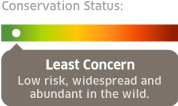
Largely a forest-dwelling species, green-winged macaws, along with many of their parrot relatives, are under pressure from deforestation and human population growth. They're also popular in the pet trade. Though the green-winged macaw is not classified as endangered, it has disappeared from part of its former range in Panama and is extinct in some parts of its range, including Argentina. Five other species of macaws are listed by IUCN as either Endangered or Vulnerable.