Appearance:
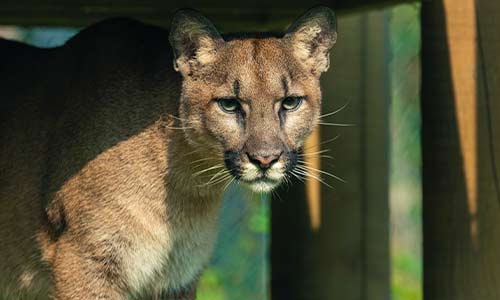
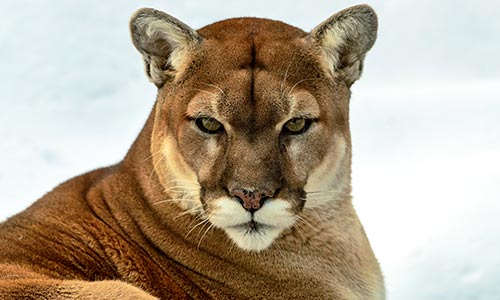
Cougars are tawny, gray or reddish depending on where they live. Cougars living closer to the equator tend to be smaller and redder; those living away from the equator are larger and gray or tan in color. They are concolor, meaning their fur is a uniform color without spots. Their front feet are larger than their back feet, and their hind legs are longer than their forelegs. This enables them to leap heights of 15 feet and 40 feet across. Their large, padded feet allow them to stalk prey silently. Their tails and bodies are long, and their heads are proportionally small. Their skulls are short and rounded, and they have powerful jaws and strong teeth to capture and eat large prey. Despite their large size, cougars are considered “lesser cats” because they don’t roar like the “big cats” do.
Size:
Cougars reach between 48 – 60 inches in length, with their long, slender tails making up one-third of their body length. Males weigh between 110 – 200 pounds while females weigh between 80 – 130 pounds.
Diet:
Cougars are opportunistic eaters (they’ll eat what comes along), though their primary prey is deer.
Reproduction:
Cougars are polygamous, and females won’t mate until they’ve established a territory, which usually takes place between 3 and 4 years of age. Gestation lasts between 82 and 96 days, with one to six cubs (three to four on average) born between April and September. Cubs are born with a spotted coat and blue eyes. They wean at 40 days of age, but will remain with their mother up to a year. They reach sexual maturity by age 2. Females usually give birth every other year.
Behavior:
Cougars are solitary animals, and they come together only to mate. They’re very territorial, defending a wide range. They spend their days hunting, often ambushing prey from a hidden vantage point in trees or behind rocks.
Habitat/Range:
Although the cougar’s United States range has diminished over the last century, they have the widest distribution of any land mammal in the Western Hemisphere. They range from the Yukon in Canada through the western portion of United States and small portion of the eastern United States to Patagonia. Cougars are found in all habitats from lowlands to mountainous regions and from deserts to tropical forests.
Life expectancy:
In the Wild: 8 – 13 years
In Captivity: 21 years
Threats in the Wild:
Though cougars are a top predator, humans are their biggest threat. Their populations are also increasingly fragmented and they are losing genetic diversity among their species.



 button in the lower right corner of the viewing window.