
Giant corpse flower on display at Franklin Park Zoo
Friday June 12, 2020
JULY 2020 UPDATE:
Please note, Fester has finished blooming and is no longer on exhibit. We'll be sure to share when a new bloom begins!
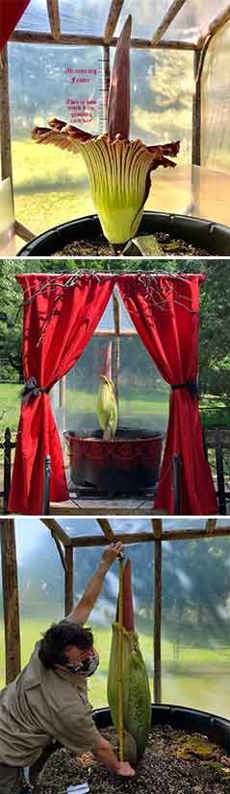 Visitors to Franklin Park Zoo may have a rare opportunity to see a titan arum in bloom in what could be unique experience to see this giant of the plant world on full display.
The plant, which can be seen in the Outback Trail section of the zoo, is expected to bloom soon, although this cannot be predicted with absolute certainty. Franklin Park Zoo is home to four corpse flowers, but the one in the Outback Trail (affectionately nicknamed Fester by staff) is the only one on public display. Fester previously bloomed in 2012 and 2014.
Called the Amorphophallus titanum — better known as a titan arum or corpse flower (due to its production of a very pungent aroma like that of a rotting carcass), these are among the most gigantic of flowers – blooms are potentially 9 feet in height and 6 feet across. Fester is currently 4 feet tall.
Titan arums are very sensitive plants and conditions must be just right for them to bloom. These plants are noted for rapid growth particularly as they near bloom, which can be 4 to 5 inches a day.
Originating from Sumatra, the corpse flower has demanding environmental requirements. This rarely observed blooming phenomenon often goes many years between blooms which last for only 24-48 hours. In the wild, these plants are scattered and the pungent smell can attract pollinators from quite a distance away.