
Adult marbled salamanders observed in Middlesex Fells by Zoo New England’s Field Conservation Team
Wednesday September 9, 2026
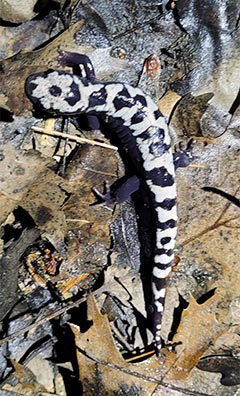 On a recent warm, rainy evening, members of Zoo New England’s (ZNE) Field Conservation Team went deep into the Middlesex Fells to search for marbled salamanders.
The team was hoping to catch a glimpse of the amphibians during their breeding and egg laying season, document the number of individuals observed and note any significant findings. Excitingly, the team observed 15 marbled salamanders, including salamanders at a new vernal pool where they had not been previously observed.
“The recent sightings show us that our reintroduction efforts have worked, and that salamanders are persisting at this site even though we have not released salamanders here since 2024,” said Matthew Kamm, Zoo New England Associate Director of Field Conservation. “This is a conservation success story showing that rare species can be brought back given sufficient protected habitat and a collaborative approach.”
Middlesex Fells, which is right next to Stone Zoo, has historically been a home to marbled salamanders in northeastern Massachusetts. During the 1930s, the salamanders became locally extinct when increasing urbanization made the habitat unsuitable for them.
In 2016, ZNE’s Field Conservation Team released the first group of young marbled salamanders in the Fells, possibly the first members of their species to occupy the area in 80 years. Reintroduction efforts continued until 2024, and comprised a total of 529 marbled salamanders released back into the Fells in the hopes of bolstering the population. In February 2023, a larval salamander at one of the Fells’ vernal pools was discovered during an Earthwise Aware biodiversity survey, marking the first sign that some of ZNE’s released juveniles effectively matured, found one another, and laid eggs. Subsequent surveys that year by ZNE biologists revealed more larvae.
The team’s recent sighting of healthy adult marbled salamanders is another huge milestone in the reintroduction of this species. ZNE’s Field Conservation team has continued to survey the Fells to map out sites of salamander activity to look for population changes over time. This project is conducted in close collaboration with MassWildlife and the Massachusetts Division of Conservation and Recreation.
Salamanders perform a vital role in what scientists call "nutrient cycling:" their amphibious lifestyle allows them to bring nutrients from aquatic ecosystems to terrestrial (dry land) ones, enriching both in the process. Like all amphibians, salamanders' sensitive skin makes them one of the best ecological "early warning" systems for climate change in addition to water and air pollution, as they begin to show signs of trouble before other species do.
The marbled salamander is a relatively large salamander ranging from Florida to southern New Hampshire. They are listed as a threatened species in Massachusetts and as a critically endangered species in New Hampshire.